Midtown student uprising
On the Come UpThe Midtown student uprising grows out of the school’s response to Brianna Jackson’s violent restraint by security guards Long and Tate. After administrators promise an investigation but leave the guards in place, Brianna’s classmates gather around her and turn her lyrics into a collective chant. The protest becomes a physical assault on the guards, drawing police, arrests, and renewed security measures; its consequences reveal how a dispute over unequal treatment can be recast as evidence that students themselves are threats.
Causes and Background
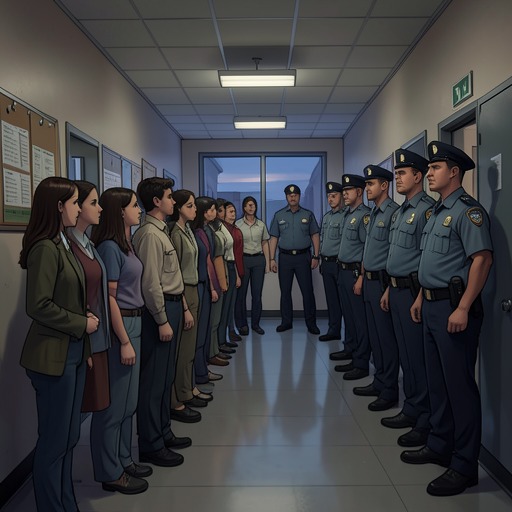
The uprising follows an earlier encounter at Midtown’s metal detectors. Curtis, Shana, Deon, three sophomores, Zane, Sonny, Malik, and Brianna pass through without setting off the detector, but Long blocks Brianna and orders her to go back. Tate justifies the order only by saying that Long gave it. During the ensuing struggle, Long forces Brianna’s arms behind her and presses her face to the floor while Tate removes her backpack. Her classmates witness the restraint, and Malik points a camera at the scene.
At the meeting with the principal, Dr. Rhodes, Jay challenges the suggestion that Brianna’s initial noncooperation explains what happened. Dr. Rhodes promises an investigation and possible discipline, then asks whether Brianna has been selling candy on campus. Jay counters that her son had previously told her guards picked on certain students more than others, and says she does not believe her children are making it up. Dr. Rhodes insists that guards treat all students the same. That institutional denial matters: the inquiry offers no immediate visible accountability, while its questioning shifts attention toward Brianna’s conduct.
The family’s discussion of school choice frames the security dispute as part of a broader system, not an isolated encounter. Jay refuses to send Brianna to Garden Heights High, where actual police serve as security and the school is treated like a prison. She argues that Midtown still gives Brianna a better chance, even as Brianna objects that its guards threw her around. Jay warns that Brianna will face more people like Long and Tate in life, but urges her not to let their actions decide what she does.
The Gathering Becomes a Protest
When Brianna returns to Midtown, she sees Long ushering another student through the detectors and Tate checking a backpack, apparently back at work. The school’s promise of an investigation has not produced an outcome she can see. Outside, many students watch her. Malik begins to shout a protest chant, but Curtis takes up Brianna’s lyrics instead, repeating the line about being pinned to the ground. Other students join in, and then the refrain “You can’t stop me, nope, nope” spreads through the crowd.
For Brianna, hearing the words travel from her own notebook into her classmates’ voices changes the meaning of the gathering. The lyrics began as her private composition, born from her thoughts and feelings; now students use them for themselves and, she understands, for her. She joins the chant. The students bounce and dance to an unheard beat, with their movement giving the moment a celebratory energy, but the scene is more confrontational than the earlier gathering in the Ring parking lot. Brianna experiences it as a call to war rather than a miniature concert.
Long and Tate emerge in the doors, and Long uses a bullhorn to order students to class, warning that they risk suspension if they do not comply. The crowd continues, adding another of Brianna’s lyrics, “Run up on me and get done up!” Long issues a final warning. The transition from chant to violence is sudden: a fist strikes Long’s jaw and knocks the bullhorn from his hand, and a cluster of boys rushes Long and Tate, bringing both guards to the ground. Curtis joins the attack as fists and kicks follow. The lyrics that gave the protest a shared voice now accompany an assault, sharply altering how the demonstration can be understood by the school and the public.
Flight and the Immediate Aftermath
Brianna’s warning that police are coming interrupts the attack. Curtis stops kicking and turns toward her; she runs with him, Sonny, Malik, and Shana as nearby sirens rise and the chants behind them give way to screams and shouts. They keep going until they can no longer hear the scene, stopping only to catch their breath. The flight separates the students who leave from those still at Midtown, but it does not end the uprising: the violence continues to define what happened even for those who were not present for its conclusion.
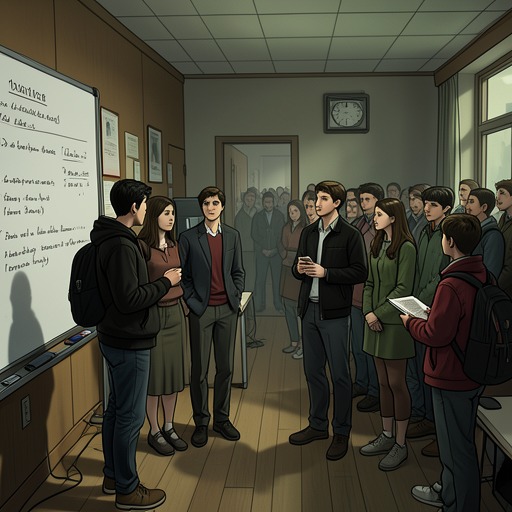
Within less than an hour, almost every Black and Latinx student from Midtown has gathered at Malik’s home for an emergency meeting organized through the student coalition. Students relay what happened after Brianna and her companions ran: at least ten police cars arrived, a news van appeared, and the boys who had attacked Long and Tate were arrested. Zane was among them. Curtis looks toward Brianna when the meeting hears this; she silently mouths that he is welcome, recalling her intervention as he was kicking the guards. Long and Tate were taken away in ambulances, though no one at the meeting knows how seriously either has been injured.
The meeting turns quickly from recounting the assault to anticipating what the school will do next. Shana expects the administration to follow the model of Garden Heights High by putting actual police in security roles. Malik argues that parents’ acceptance of the false narrative that Brianna is a drug dealer may lead them to regard all the students as threats, and predicts armed officers at the doors. His forecast connects the earlier suspicion directed at Brianna to the broader security response: a protest against the treatment of students risks being answered with a more forceful apparatus of surveillance and control. For Brianna, the prospect is also personal. Since a boy was killed, seeing a police officer makes her heart race; she reflects that chance alone separated her from the boy who died, and fears that her anxiety may now follow her through much of the day.
The television report confirms arrests and the guards’ hospitalization, while saying that they are expected to make a full recovery. It also reports that students have been sent home as school officials determine what to do next. Jay turns off the television and asks Brianna directly whether she was involved. The report’s compressed account places the injuries, arrests, and school closure at the center of the public story; at home, the question becomes what her part in the event was, rather than whether the original treatment of students has been addressed.
Institutional Response and Its Consequences
In the days after the uprising, the school’s stated commitment to an investigation remains difficult to distinguish from inaction. Brianna later sees Long and Tate back at the metal detectors: Long ushers a student through while Tate checks a nearby backpack. Their return gives the earlier promise of possible disciplinary action a concrete, dispiriting answer. The uprising has made the guards’ treatment of Brianna impossible to ignore, yet the visible routine at Midtown has resumed around the same officers.
The school district’s public explanation emphasizes security rather than the students’ complaints. At a meeting, a parent questions why children face metal detectors, random pat-downs, and armed police, objecting that the school is not a prison. Superintendent Cook cites recent crime increases in the area as the reason for heightened security but does not explain the armed officers. The explanation leaves the underlying tension intact: measures presented as protection can make the school resemble the punitive environment Jay had described at Garden Heights High, where actual police serve as security and students are not set up to succeed.
The uprising also shows how quickly an institutional dispute can be reframed. The students’ gathering begins with Brianna’s classmates taking up her words after the guards’ return, but it ends with guards hospitalized, students arrested, and the school sending students home. In a later television report, the arrests and injuries are the central facts; the guards are expected to recover, and school officials are deciding what to do next. That account records the consequences of the assault without resolving the complaint that gave the protest its force.
The punitive chain reaches beyond the school gates. Aunt Pooh, imprisoned after the Maple Grove raid, tells Jay that Law’s chain was stolen and that the thieves bragged about pointing a gun at Brianna. Jay rejects the demand for retaliation, insisting that Brianna is safe and that the chain matters less than her daughter’s life. Her response echoes the family’s earlier effort to keep Brianna away from a school governed by armed police: protection is not secured simply by answering danger with more force. Across the uprising’s aftermath, however, police presence, arrests, and the prospect of armed school security remain the institutions’ most visible answers.